The Kunstmuseum Den Haag (formerly Gemeentemuseum) has one of the largest collections of Mondrian's paintings.
Michael Sciam's studies provide valuable insight into many of these paintings.
Presuming that the museum would be interested to know about in 2006 Sciam sent a copy of his essay to Mr. Hans Janssen who at that time was in charge of the above mentioned collection and had already published some catalogues about Mondrian.
Since then Mr. Janssen refused to aknowledge Sciam's contribution. Faced with self-explanatory documents, the curator went on arguing that Sciam's contribution was not interesting enough. Years later, after Mr. Janssen death (r.i.p.), Mr. Benno Tempel (former director of Kunstmuseum Den Haag), curators Caro Verbeek and Laura Stamps and few other people "discovered" that Sciam's ideas could be useful and, in a disguised form, used them in some exhibition catalogs without mentioning the original source. Some details can be found here.
Here is the story since the beginning when the Kunstmuseum Den Haag was still named Haags Gemeentemuseum:
In 1992 Sciam sent a copy of his first essay on Broadway Boogie Woogie to several people including Hans Janssen. No answer.
After completing his studies on Mondrian's entire oeuvre in 2005 a copy of the publication was again sent out to the Haags Gemeentemuseum. Once again no answer ever came. After a while, Sciam wrote to Mr. Wim Van Krimpen (at that time director of the Gemeentemuseum) and finally got an answer from Mr. Janssen.
Sciam replied to Mr. Janssen's as follows. Once again no reaction ever came from the Gemeentemuseum.
Sciam wrote a letter to Her Majesty the Queen of the Netherlands and received this answer.
Hoping to find a more co-operative person, in 2014 Sciam wrote to the new director of the Haags Gemeentemuseum Mr. Benno Tempel who, unfortunately did not reply. Sciam got instead this mail from Hans Janssen.
Let us for a moment examine what Hans Janssen writes in his letter of 2008.
"Most of the time however, I see that where the artist talks about evolution, he paints completely differently. This often happens with artists. What they talk about isn’t necessarily what they actually do in their paintings. A main error in most art historical studies by amateurs, is that they take what the artist says for granted. "
Mr. Janssen tries to diminish the importance of Sciam's studies talking about "historical studies by amateurs".
Sciam's are not "historical studies" as he clearly states in his 2006 essay: "I have deliberately overlooked the biographical aspects regarding Piet Mondrian, as other scholars have already addressed these expertly at great length."
Most important, the curator seems to be warning about "taking what the artists say for granted" but, as a matter of fact, this is indeed what Mr. Janssen has been doing in his catalogues on Mondrian where he often tries to explain the paintings with the aid of letters the artist wrote to some collegues and friends. Look at the mail Sciam sends on 27 March 2019 to Hans Janssen:

Dear Mr. Janssen,
I read with pleasure some essays of yours on Piet Mondrian’s oeuvre.
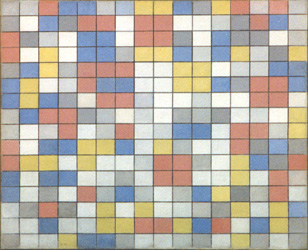
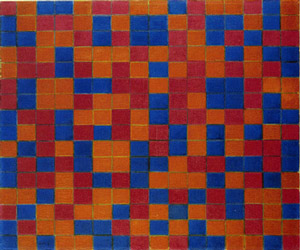
At pages 154-155 of the catalogue for the 2005 Mondrian exhibition at the Vienna Albertina Museum (Prestel) you write about the Checkerboard with Light Colors (Fig. 1) and the Checkerboard with Dark Colors (Fig. 2).
 |
 |
||
Fig. 1 |
Checkerboard Compositon with Light Colors,
1919, Gemeentemuseum, The Hague |
Fig. 2 |
Checkerboard Compositon with Dark Colors,
1919, Gemeentemuseum, The Hague |
Your explanation refers to a letter Mondrian wrote to van Doesburg. Based on what Mondrian wrote, you assume that a night and a daylight sky could be the source for these two works. Your explanation goes on saying that if the colors of the dark version evoke nightlight, then the colors of the light version may hint to a daylight motif. To corroborate this interpretation you focus on a larger dark-blue rectangle in the dark colored version (a supposed evidence for the night sky) and a light pink rectangle in the light colored version (presumably evoking daylight).
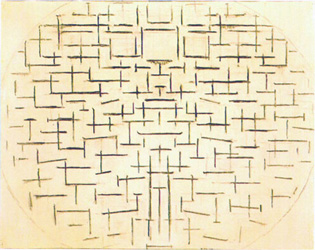
You then set a relation between these rectangles and a square which is visible in the upper central area of Pier and Ocean 4 (Fig. 3). You talk about that square as an empty space suggesting the sky. You finally point out that a significative difference between the two Checkerboard compositions lays in the tones of gray and white of the light colored version (Fig. 1) which are absent in Fig. 2 and conclude that this difference "remains somehow unexplained". |
 |
||
Fig. 3 |
Pier and Ocean 4, 1914, Gemeentemuseum, The Hague | ||
The book showing the results of my studies on Mondrian, which I have sent to you in 2006, provides, among others,
some explanations to the above. I now take the liberty to submit the same to you again through the following extract from the entire file dealing with both Checkerboard compositions:

Sciam tries to point out that the explanations he was able to provide with his essay in 2006 could have clarified what had remained unexplained to Mr. Janssen in 2005. How comes a curator, working for a public museum and paid with public money, whose main function should be to improve the level of knowledge, did not bother considering the above?
The message Sciam writes to Hans Janssen continues as follows:
In the letter you have sent to me, you rightly point out that, “what artists talk about isn’t necessarily what they actually do in their paintings”. I agree with you as I think that Checkerboards with Light and Dark Colors have little to do with night or daylight, rather, with the fundamental issue of the multiple and the one Piet Mondrian has been dealing with throughout his entire life. Further details on this theme can be found, if you wish here.
Going back for a moment to Pier and Ocean 4 (Fig. 3), I do not think, as you write in your catalog, that the square in the upper-central area of the composition evokes the sky, rather, I see in that square proportion the interpenetration between the spiritual (symbolized by the vertical pier) and the natural (the boundless horizontal extension of the sea). More on this in this extract from the entire file dealing with the Pier and Ocean series of works:


The square therefore does not "evoke the sky" as you have stated but, rather, the moment when the Spiritual (evoked by the vertical line of the pier) and the Natural (evoked by the horizontal line of the sea) reach equilibrium, that is, when he opposites reach equivalence as Mondrian used to say.
In the catalogue for the Mondrian exhibition at the Wiesbaden Museum you describe Composition with Large Red Plane, Yellow, Black, Gray and Blue (1921) and talk about a “module”. May I suggest that this module is in fact a square proportion?

Don’t you think Mr. Janssen that it would be fair and to everybody’s advantage if a museum which owns one of the most significant Mondrian’s collections would consider any substantial improvement to the understanding of his oeuvre?
I am open to any proposal.
With best wishes,
Michael Sciam
And this is how Hans Janssen's replies:

Dear Michael Sciam,
there we go again… I asked you to refrain from using this email address.
Sincerely,
Hans Janssen
Hoofdconservator moderne kunst / curator at large for modern art
To this kind of unusual answer Sciam replies as follows:

Dear Mr. Janssen,
I would not bother writing to you if you were not responsible for one the most significant collections of Piet Mondrian’s paintings.
To be responsible means also to be open to any significative contribution aimed at improving the knowledge about the Dutch master.
I have sent to you a text presenting some reflections implementing the explanation you gave of some works of Mondrian. While your essays provide very useful historical information, I think that some visual aspects need further consideration in order to come up with the full content of those paintings and more in general with the evolution process of Mondrian’s oeuvre.
Why do you get so nervous when asked to evaluate a point of view other than yours? Why are you a priori so reluctant to consider additional explanations from me? Is there a plausible reason for that? Or is it a problem the fact that I am an artist and do not belong to the circle of friends curators and art critics? You know Mr. Janssen, sometimes artists have things to say about art.
I regret having to be so outspoken but I must remind you that you do not manage your own private gallery. There are limits to personal discretionary power if you work for a public institution.
Once again let me kindly ask you to reconsider your prejudicial refusal of my contributions and allow for a constructive cooperation.
With best wishes,
Michael Sciam
Faced with precise visual matter, the chief curator of modern art Hans Janssen disappears.
So sometime later Sciam sends this mail to him:

Dear Mr. Janssen,
With my mail of 27 Mach 2019 I have posed to you questions regarding specific visual aspects of both Checkerboards with Light and Dark Colors, Pier and Ocean 4 and Mondrian’s oeuvre in general. Instead of responding in a constructive way, you scream at me and flee away. Do you disappear because you do not want to admit that my suggestions do have a ground as does the whole essay I have sent to you in 2006?
You have been saying throughout the years that you did not find that essay interesting and therefore kept silent. I have now showed to you that my essay contained, among others, answers to questions pertaining to the above mentioned paintings you were not able to answer in 2005. Is this the reason of your silence?
You and some colleagues of yours should listen to artists and especially those you deliberately ignore. Listening to artists is just the most natural thing since all of your doing is based on what we, the artist, do decades before historians, critics and curators begin doing their job. I am afraid you are no exception to all those people who refused artists at the official salons, decided not to admit Mondrian at the Prix de Rome, called beasts artists who “mis-used” colors and so on. Albert Einstein once said that “great spirits have always encountered violent opposition from mediocre minds.”
Be reassured Mr. Janssen as I will untiringly keep tackling your censorship.
With best regards
Michael Sciam
This time Sciam does not focus on any specific visual matter and so Janssen feels free to answer:

Dear Michele Sciam,
you seem to suffer from some misconceptions, with which I maybe could help you by providing some information. I am not an authority; I am not a Professor; I am working outside of Academia; I look carefully at contemporary art and listen carefully, and with great joy, to living visual artists, they form my main inspiration for all my activities in the historical realm. You are right in one respect, I have to admit: I am suffering from a mediocre mind, I wouldn’t dare to compare myself to Albert Einstein. I mainly ask questions, I don’t enforce answers upon history, and I don’t enforce answers upon the people for whom I am writing.
I understand you are fascinated by the work of Mondrian, and I understand also you want to share enthusiastically your findings. But, once again: I am not convinced. Is that bad? I wouldn’t think so.
Yours sincerely,
Hans Janssen
Hoofdconservator moderne kunst / curator at large for modern art
This man does not realize that Sciam is not really expecting answers from Hans Janssen, rather from the Chief Curator at Kunstmuseum Den Haag (formerly Haags Gemeentemuseum) whose main role, among others, should be to promote understanding and enjoyment of the artworks in their collection. In fulfilling this duty a Chief Curator should be open to external, additional and valuable contributions unless he wants to consider his point of view only. He doesn't really care if the public is deprived of different approaches which could better explain Mondrian paintings including some aspects which remained unexplained to him. The public can wait.. although the monthly wage of this man is being paid by the public.
This is how Sciam replies to Hans Janssen's mail of 29 April:
Dear Mr. Janssen,
You may not have the legal title of professor and not officially belong to the academia but you seem to have the same kind of conservative attitude. The very simple fact that you had to define me as “an amateur” in your letter of 2008 is a clear evidence of the walls you need to raise in order to avoid unexpected confrontation with the real world.
You fearfully avoid answering the specific visual questions I have posed with my mail of 27 March as any intellectually honest scholar who works for the sake of knowledge would do. An overwhelming ego makes it difficult for you to admit that my contributions prove effective. The organic view I have supplied of Mondrian’s oeuvre, considered as one ideal image evolving from 1901 up to 1943, outlines a dynamic picture of the whole that was and still is missing. If one is not convinced by this new approach he is either blind or in bad faith.
Quoting Mondrian in the Vienna Albertina catalog you write “..a destruction of the natural and a reconstruction of it through the spiritual...” but then you do not see that the small rectangles of different shades of gray in the checkerboard with light colors progressively concentrate in a larger white central rectangle representing the spiritual quest for unity faced with the multiple appearance of nature (the yellow, red and blu rectangles). Doesn’t this represent in purely visual terms the “reconstruction of the natural through the spiritual?"
Do I have to remind you that at this stage the painter identified yellow, red and blue with the natural whereas white, gray and black were to symbolize the spiritual? Isn’t this convincing enough? How long will you go on ignoring the evidence? It is embarrassing to see how you try to hide behind a finger.
This dialectic between the multiplicity of the natural and the unity wished for by the spiritual can be seen already in 1899 (Wood of Beech Trees), 1901 (Apples with Ginger Pot and Plate on a Ledge), in the several versions of the single tree (1908-12), in Composition II (1913), Pier and Ocean 4 and 5 and all along the Neoplastic phase up until Broadway Boogie Woogie.
Do I have to underline that such a dialectic is at the core of philosophical and spiritual thought? Doesn’t this make you think that, in some cases such as Mondrian's, form becomes a great deal of content? You wrote that my approach was “too formalistic and therefore not your cup of tea”. As you are now becoming aware of, this “cup of tea” can explain many things which remained unexplained to you.
You say over and over again that you work with many people around the world. In the catalogs you have published so far I can see that you mostly work with people who write about many different things but no one really engaging in a thoughtful and extensive analysis of Mondrian’s oeuvre. In the catalog for the Brescia exhibition a friend of yours had the privilege to copy and paste texts you had published in 2002 with “The Path to Abstraction”. For the exhibition in Rome you did not even bother writing a new text but used one you had published for a previous exhibition.
What I see is that you like to work with those who stay at safe distance from the paintings and therefore do not represent a threat to your quest for playing the role of “The Mondrian specialist”. There is a big difference between bureaucratic authority and intellectual authority. The first often tries to hold back progress the second works for it. As usual with art, time will tell.
Best
Michael Sciam
With the following message the curator once again carefully avoids to be confronted with specific visual topics:

Dear Michele Sciam,
I don’t understand really why you are so persistently insulting and degrading. Does this give you a good feeling? Don’t you have a wife to shout at? As always,
Hans Janssen
Hoofdconservator moderne kunst / curator at large for modern art
Sciam's reply:
Dear Mr. Janssen,
Many times I have tried to establish with you a constructive communication based on specific visual matter related to Mondrian’s oeuvre which you have always intentionally overlooked in order to avoid admitting I had a point. If you feel insulted and degraded by this, then, I am sorry, but you should blame your own behavior. Pinpointing this kind of behaviour is not a source of good feeling for me. I am not so miserable to enjoy such an unfair and low-level type of communication.
It is indeed degrading that a person who has in charge a Mondrian collection is not able to deal with substantial issues pertaining to works in that collection and above all is not willing to accept suggestions aimed at implementing the understanding of aspects which remained unexplained to him. It is however my fault: I have confused a museum employee with a person of culture. I am afraid you do not work for the sake of knowledge and art but mostly to sell catalogs and tickets. I do apologize for this misunderstanding.
Very Truly Yours
Michael Sciam
P.S.: for you wives are there to be shouted at?