The preference for placing a synthesis at the center of the composition also recurs in some abstract works:

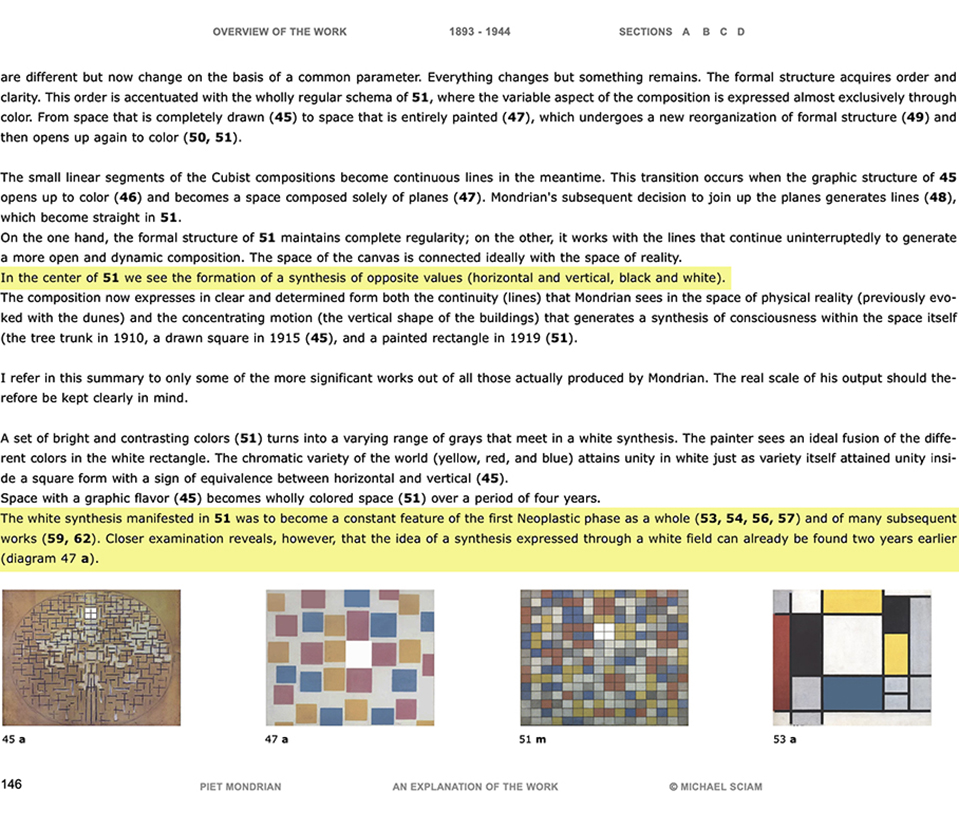
In the above excerpt from Sciam's 2006 essay the author highlights the white area Mondrian places in the center of the composition between 1915 and 1920 as a suggestion of a synthesis of the opposite directions (horizontal and vertical) and the various colors.
Many times since 2006 Sciam has tried to draw Hans Janssen's and BennoTempel's attention to the above and this is the kind of answer Sciam got from Mr. Janssen on behalf of Mr. Tempel >
Same as the vertical trunk of a tree unifies a rather chaotic set of branches (1912), a rectangle (1913) and then a square (1915) unify a multifarious set of unbalanced relationships between horizontal and vertical lines. This variety is a plastic rendering of the ever-changing manifold space of the world:
 |
 |
 |
||
| Study of Trees 1, 1912 |
Compostion II, 1913 |
Pier and Ocean 5, 1915 |
||
By reducing reality to a multitude of orthogonal signs, Mondrian undoubtedly performs an arbitrary operation with respect to everything we see. This enables him, however, to express the widest diversity on the canvas while at the same time maintaining something more constant (the horizontal / vertical relationship).
A so called "realistic" painting, built on the illusion of a third, non existing dimension (1912), turns into a concrete space consisting of the two real dimensions of painting (1915).
The process of abstraction enables the artist to address the endless multiplicity of the outer world without neglecting a sense of unity to which he aspires in the depth of his spirit. Every sign differs from the others but they all share the same intimate nature (the perpendicular relationship), just as every human being, every animal or tree is unique and unrepeatable but all express some fundamental characteristics that make it possible to discern an invisible overall design.
Mondrian attaches great importance to this, which is why he places the synthesis at the center of a manifold composition.
From now on, the artist will work to interpenetrate the one and the many, that is, what he calls the Spiritual and the Natural, until his last completed work, Broadway Boogie Woogie, where the many becomes one and the one reopens to the many.